| The Organs and History of Trinity Church Pottsville, Pennsylvania |
Part II: "To Help Us See God"
|
In 1888, the appearance of the church -- and the location of the organ -- changed. The Chancel area of the church was enlarged, and extensive renovations were undertaken including frescoing done by the J & R Lamb Studios. Stained hard pine replaced plaster on the nave ceiling and aisles; the vestibule and steps were redone to ease the pitch on the stairs; and the Hook and Hastings Company of Boston installed their Opus 1368, a two manual, 25 stop organ, a gift from Mr. F. G. Yuengling.
On June 9, 1888, the organists of the Cathedral (then in Reading, PA), the First Presbyterian Church, and our own organist, John Sinclair, plus the Cathedral Vested Choir presented "…one of the most delightful entertainments ever given in this town…" (The Trinity Church Monthly). With this move to the front of the church, the choir became a "Vested Choir," singing from the Chancel.
By 1891, under the direction of Mr. A. S. Haughton, former resident organist for Margate College, England, a second choir consisting of men and boys in the English Cathedral tradition, was begun. The Trinity Church Monthly contains an advertisement seeking boys to sing in the choir paying "…from 30 cents to $1.25 per month, according to ability…" The J. C. B. Standbridge organ, with the handsome case we see today, was retained in its gallery home.
The architectural evolution of the church, linked closely with an emphasis on a quality music program that included the purchase of a new pipe organ with each enlargement and renovation of the church, was made possible by the Anthracite coal from Schuylkill County that helped fuel the factories of the war machine that won the Civil War for the Union. The railroad down the Schuylkill Valley from Pottsville to Philadelphia was a main route of access and commerce; the social, cultural, and intellectual life of Pottsville was firmly tied to Philadelphia, which was its metropolis. There is no doubt that the leading citizens of Pottsville, and Trinity Church, with wealth resulting from the mining of coal, the production of steel, the brewing of beer, and other industries, aspired to the high culture and sophistication of the eastern cities, and the evidence of that is apparent in the architecture and appointments we see today.
|
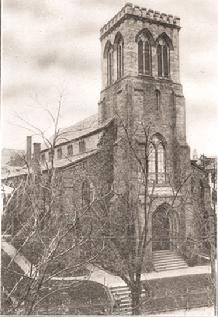 |
| Trinity Church Prior to 1906 |
|
|
 |
| Interior Prior to 1921 |
|
|
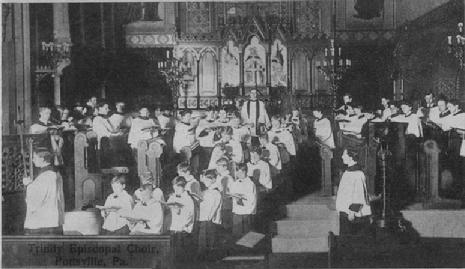 |
| Trinity Church Choir |
|
|
In July, 1921, the Chancel in the front of the church was boarded up and an improvised chancel was erected. The work of taking down the organ and demolishing the old chancel began. On July 28, 1921, a contract in the amount of $17,500.00 was signed with Austin Organ Company, Hartford, Connecticut, to build Opus 1040, our present instrument. Consisting of three manuals and thirty four stops, including a five stop Echo Organ built in the 1866 Gallery Case, it was said that “…the tone of the organ was so rich and beautiful that everyone who hears it is led to comment on it…” (The Trinity Church Monthly). Mr. Harry B. Haag, A.A.G.O., was organist and choir director at that time. Austin Opus 1041, a five rank, two manual unit organ, was built in the Chapel of the Resurrection in Charles Baber Cemetery concurrently with the organ in the church.
The Trinity Church Monthly records that in celebration of the Feast of All Saints, 1922, the new Choir, Sanctuary, the Austin Organ, and various memorial gifts were blessed, with the Bishop in attendance. The words of the Rector, The Reverend Howard W. Diller, as he reflected on the event, ring true to the mission of our church even to this present day:
“…Now that we have this exceedingly beautiful church and
the wonderful organ, what are we going to do with them?
The rector sincerely hopes that they are going to be used
to the utmost, not only by our own people but by others,
also. Unless the Church, its architectural beauty, its music,
and service are to be given the opportunity to help us see God,
to lift up our hearts to Him and to inspire us to go forth and do
His work in the world, our efforts to make our House of God for
beauty and for glory will be to no purpose. However, we believe
that our people are going to appreciate as never before the
privilege and blessing of assembling themselves to gather for
common worship and communion with God, that they are going
to work as never before to set forward the Kingdom of God
in this community, this Diocese, this country, and even onto
the utmost parts of the world…”
The architects of the English Choir style Chancel that we see at Trinity today were Zantzinger, Borie, and Medary, of Philadelphia. Zantzinger and Borie later did the preliminary design work for the Philadelphia Museum of Art, and the firm also designed the Washington Memorial Chapel at Valley Forge; the Detroit Institute of Arts; and the Fidelity Mutual Life Insurance Company Building in Philadelphia.
The remarkable stained glass window over the main altar was designed by Nicola D’Ascenzo, who later designed The Great West Window, “The Second Coming,” at the Chapel of Princeton University, and the “Communications Window” in the Cathedral of St. John the Divine, New York City.
|
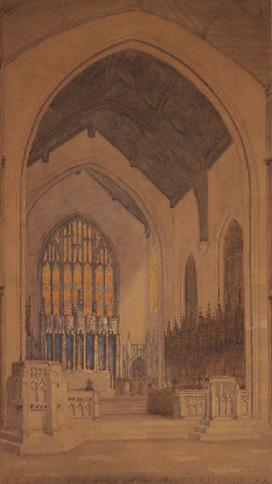 |
| Original architect's drawing of the proposed expansion (1921) |
|
|
|